
This was
your sky.
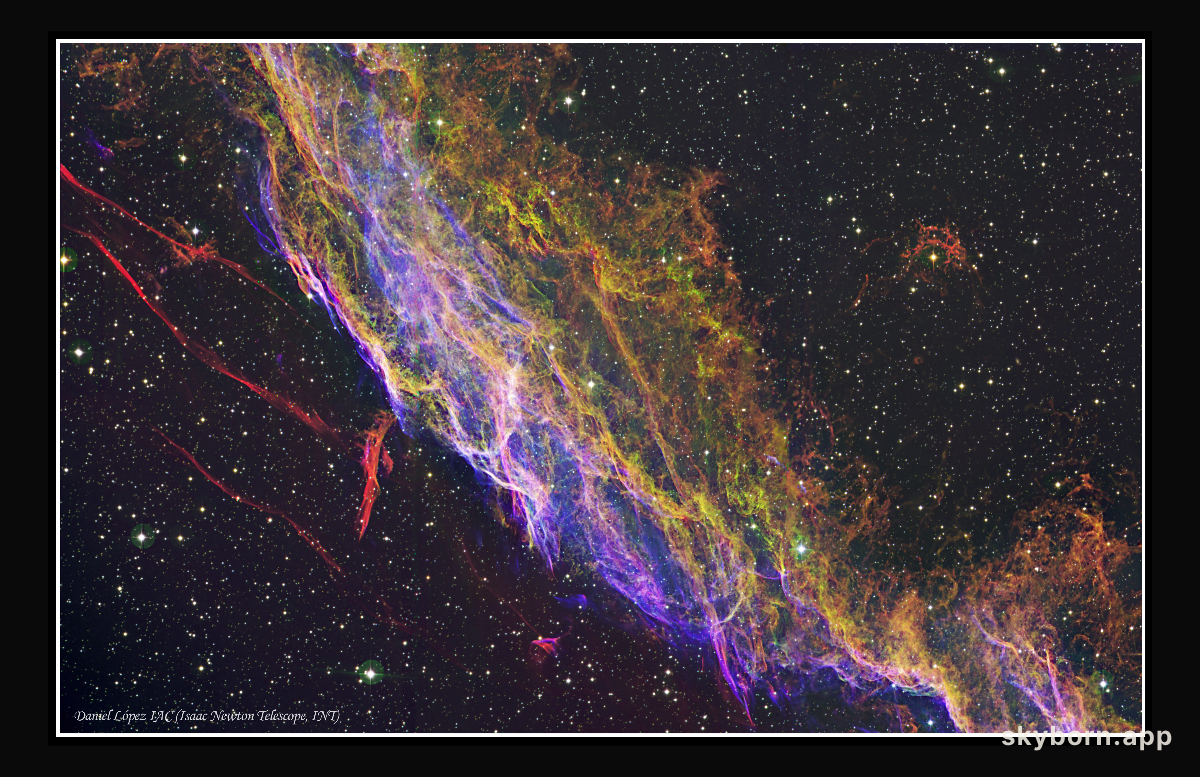
NGC 6992: Filaments of the Veil Nebula
Wisps like this are all that remain visible of a Milky Way star. About 7,500 years ago that star exploded in a supernova leaving the Veil Nebula, also known as the Cygnus Loop. At the time, the expanding cloud was likely as bright as a crescent Moon, remaining visible for weeks to people living at the dawn of recorded history. Today, the resulting supernova remnant has faded and is now visible only through a small telescope directed toward the constellation of the Swan, Cygnus.
We cannot put this date's photograph on paper at poster size. We can print the nearest public archive plate to your date instead.
See print sizesFrom $29.00

In tropical astrology, 1 DEC 2009 falls under Sagittarius (♐). The sign's window runs from 11-22 through 12-21. Sagittarius points straight at the center of the Milky Way, our galaxy's brightest region. The Sun was crossing this region of the sky on 1 DEC 2009.